1.5 Authenticating with GitHub
Story problem
Why does GitHub keep refusing me?
You have followed Section 1.3, you have a GitHub account, you have installed GitHub Desktop, and your class343 project is sitting happily under version control. Then Lab 6 asks you to Publish repository in GitHub Desktop, and either nothing happens, the publish button spins forever, or you see a message like:
Authentication failed. Some common reasons include:
- You are not signed in to GitHub.com
- Your credentials have expired
This is not a bug. GitHub refuses anonymous pushes, and since 2021 it no longer accepts your account password as a credential. Signing in to github.com in a browser is only half of it: GitHub Desktop also needs a valid credential for your account. The simplest way to provide one is a personal access token (PAT) that lasts the whole semester.
What you will learn
- Why GitHub needs a second form of authentication, even after you sign in to github.com in a browser
- How to confirm you are logged in to the right GitHub account
- How to create a fine-grained personal access token that lasts the full semester
- How to sign in to GitHub Desktop with that token
- What to do when things still go wrong
SSH keys are the other supported method and are what most developers use day to day on the terminal. They are a bit more involved to set up (key generation, agents, ~/.ssh/config) and some university or corporate networks block outbound port 22, which breaks SSH entirely.
For this course we recommend a personal access token because it works everywhere, plays nicely with GitHub Desktop, and takes about five minutes. If you want to learn SSH later, GitHub has a good walkthrough: Connecting to GitHub with SSH.
Step 0: Make sure you are logged in to GitHub
Before you generate anything, confirm that your browser is signed in as the GitHub account you intend to push from. This sounds obvious, but many auth failures come from the laptop pushing as one user while the browser is logged in as another (often a personal vs. university account).
- Open github.com in the browser you will use for the rest of this workflow.
- Click your avatar in the top-right corner. Confirm the username shown is the one you signed up with in Section 1.3, using your University of Auckland email.
- If it is the wrong account, sign out and sign back in as the correct one.
- While you are there, click Your repositories and make sure you can see the repos you expect. If you cannot, you are signed in to the wrong account.
Keep this tab open. You will come back to it in Step 2.
GitHub requires 2FA for most accounts now. If you have not set it up, do so before generating a token: Settings -> Password and authentication. You can use an authenticator app (recommended) or SMS. The token flow below assumes 2FA is enabled.
Step 1: Understand what a personal access token is
A personal access token (PAT) is a long random string that acts as a scoped replacement for your password. A few properties worth knowing:
- It belongs to you, not to a particular machine. The same token can be used on your laptop and your office desktop, or revoked from either.
- You can limit which repositories it can touch and what it can do (read only, read + write, etc.).
- It has an expiry date. When it expires, GitHub Desktop starts failing to push until you generate a new one.
- If it leaks, you revoke it from a web page, not by changing your password.
GitHub offers two kinds of tokens:
- Classic tokens (what we will use below). Scoped with a small set of permissions such as
repo, which covers everything you need for this course. - Fine-grained tokens (newer). Let you restrict a token to specific repositories and individual permissions. Worth learning once you are comfortable, but overkill for a classroom workflow.
For the full reference on how tokens work, when to use which, and how to manage expiry, see the official GitHub docs: Managing your personal access tokens – Creating a personal access token (classic).
Step 2: Generate a personal access token (classic)
- Still signed in to GitHub, open github.com/settings/tokens.
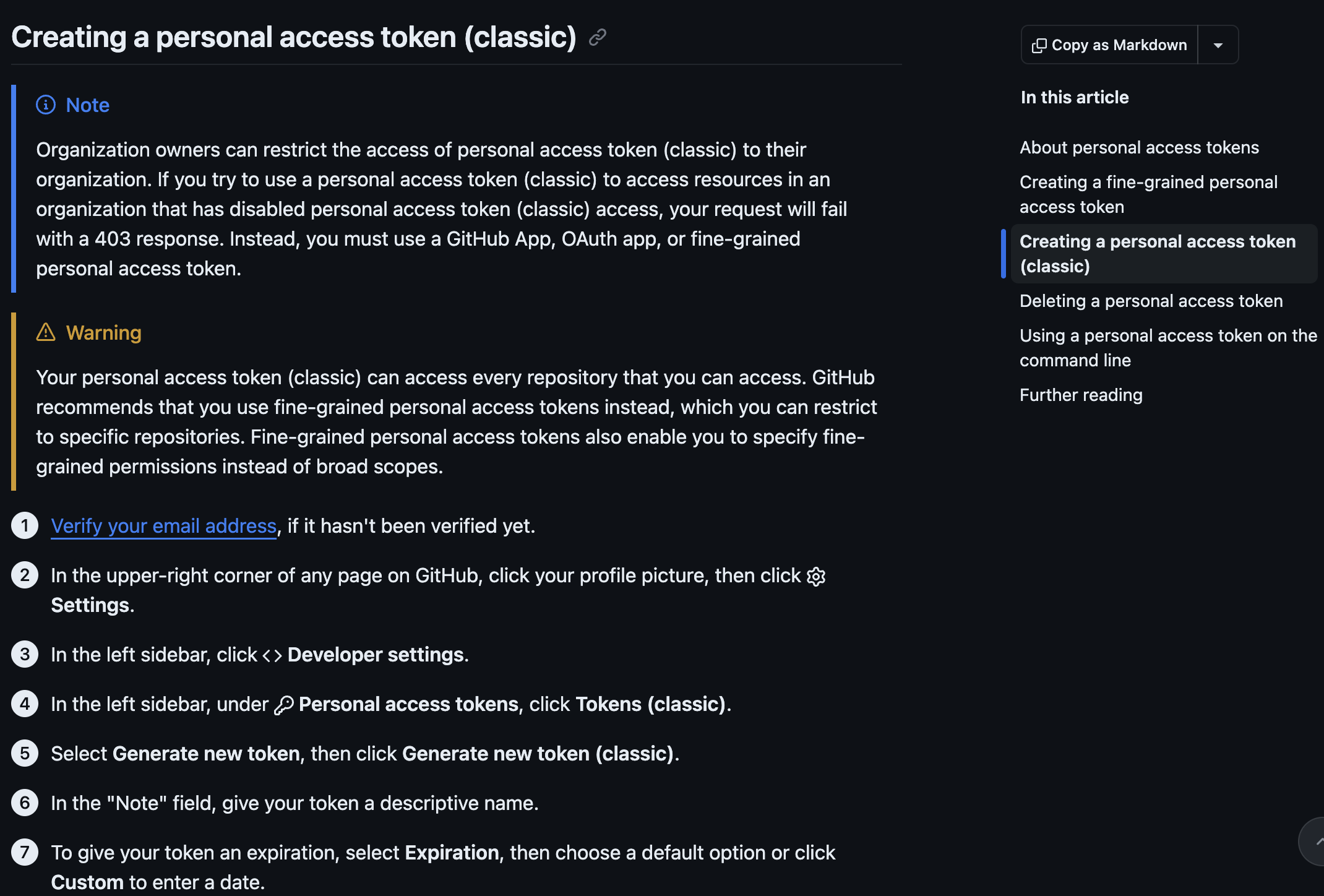
- Click Generate new token, then Generate new token (classic). If GitHub asks you to confirm your password or a 2FA code, do so.
- Note: something you will recognise in six months, e.g.
UoA laptop (2026), GISCI 343. - Expiration: pick 90 days. This covers the remainder of the semester (including the Assignment 2 deadline on 10 May 2026 and any follow-up marking), so you will not need to regenerate before the course ends. If you prefer a fixed end date, use Custom and pick one just past the end of semester.
- Select scopes: tick
repo(the whole block: repo:status, repo_deployment, public_repo, repo:invite, security_events will all highlight). That is all you need for cloning, pushing and publishing repositories from GitHub Desktop. Leave every other scope unticked. - Click Generate token at the bottom of the page.
- GitHub shows the token exactly once, as a string starting
ghp_.... Copy it now into a secure place (a password manager if you have one). If you lose it, you will have to regenerate.
For reference, please visit https://docs.github.com/en/authentication/keeping-your-account-and-data-secure/managing-your-personal-access-tokens#creating-a-personal-access-token-classic (screenshot below)
Anyone with your PAT can push and pull from your repos as you. Do not paste it into chat, commit it to git, email it to yourself, or store it in a plain text file in your project folder. If you suspect it has leaked, revoke it immediately from github.com/settings/tokens and generate a new one.
Put a reminder in your calendar two weeks before the token expiry date. When it pops up, come back to this section and generate a new one. Future-you will thank present-you.
Step 3: Sign in to GitHub Desktop
GitHub Desktop stores your credentials once and reuses them for every push afterwards. Do this once and Lab 6, Lab 7, and Assignment 2 will all just work.
- Open GitHub Desktop. On macOS, go to GitHub Desktop -> Settings -> Accounts. On Windows, go to File -> Options -> Accounts. If a wrong account is already listed (e.g. a personal account instead of your UoA one), click Sign out first, then Sign In next to GitHub.com.
- In the sign-in dialog, click Sign in using your browser.
- Your browser opens a GitHub page that says something like “GitHub Desktop would like permission to access your account”. Make sure the account shown is the correct one (the username from Step 0). If it is not, click Not
? and switch. - Click Authorize desktop.
- The browser hands control back to GitHub Desktop, which now shows your username and avatar under Accounts with a green tick. Close the settings window.
To verify, open (or reopen) any repository in GitHub Desktop and hit Fetch origin in the top bar. If the button spins for a second and then settles quietly, authentication is working.
If the browser opens and you click Authorize desktop but GitHub Desktop stays stuck on the sign-in screen (rare, usually a locked-down network or an ad-blocker), you can sign in manually instead. In the sign-in dialog, choose the username and password option, put your GitHub username in the username field, and paste the token from Step 2 into the password field.
Troubleshooting
“Authentication failed” when I click Publish repository
Your stored credential has expired, been revoked, or never worked in the first place.
- Check the token is still active at github.com/settings/tokens. If it has expired, generate a new one (Step 2) and sign back in (Step 3).
- In GitHub Desktop, sign out of the account (Settings / Options -> Accounts -> Sign out), then sign in again.
The browser sign-in never completes
The browser opens, you click Authorize desktop, but GitHub Desktop does not register the login. This is usually a network or browser extension issue.
- Try a different browser as the default (Chrome, Edge, Firefox, Safari).
- Disable any ad-blocker or privacy extension temporarily and retry.
- Fall back to the token path in Step 3c.
GitHub Desktop keeps pushing as the wrong user
You have two accounts signed in, or the cached credential belongs to someone else. Sign out fully, clear any github.com entries from your OS credential store (Keychain on macOS, Credential Manager on Windows), and sign in again with the correct account.
“Could not resolve host: github.com”
Not an auth problem, a network one. Check your wifi, try a different network, or check whether your university VPN is filtering DNS.
Publish repository says “already exists”
Not an auth problem either. The repository on GitHub already has content (often a README) that your local repo does not know about. See the Lab 6 callout on non-empty remotes.
I really need to use the terminal
Section 1.5 assumes GitHub Desktop. If you prefer the command line, GitHub’s guide walks through the credential helper setup in full: Caching your GitHub credentials in Git. The same token you generated in Step 2 works there.
Summary
You now know:
- Why
Publish repositoryneeds its own authentication, even after you have signed in to GitHub.com in a browser - How to check you are on the correct GitHub account before you generate anything
- How to create a fine-grained personal access token that lasts the whole semester
- How to sign GitHub Desktop in with that token (browser path or token path)
- How to diagnose the common failure modes
Key insight: do this once, and every lab afterwards (Lab 6, Lab 7, your Assignment 2 deployment) just works. Skip it, and you will spend lab time fighting Authentication failed instead of doing GIS.
Quick reference
One-time PAT + GitHub Desktop setup
0. Confirm you are signed in to the correct GitHub account in the browser.
1. Generate a classic token:
   https://github.com/settings/tokens
   Generate new token -> Generate new token (classic)
   Expiration: 90 days (covers the semester)
   Scope: tick `repo`
   Copy the token now (shown only once, starts with ghp_).
2. Open GitHub Desktop.
   macOS:   GitHub Desktop -> Settings -> Accounts -> Sign In
   Windows: File -> Options -> Accounts -> Sign In
3. Sign in using your browser -> Authorize desktop.
   (If that stalls, paste the token in the password field of the manual sign-in.)
4. Fetch origin on any repo. If it works silently, you are done.
Additional resources
- GitHub Docs: Managing your personal access tokens – Creating a personal access token (classic) (the authoritative reference for this section)
- GitHub Docs: Authenticating to GitHub in GitHub Desktop
- GitHub Docs: Caching your GitHub credentials in Git (if you end up using the terminal later)
- GitHub Docs: Connecting to GitHub with SSH (if you would rather use an SSH key)